Smaller Guest List, Bigger Questions: Inside the Quiet Rebellion Against the Big Fat Indian Wedding
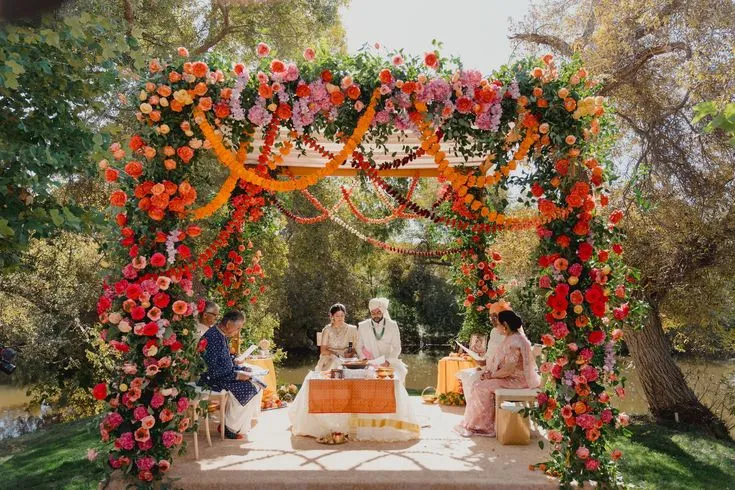
Photo: small intimate Indian wedding ceremony in backyard with marigold decorations and few guests, via i.pinimg.com
Somewhere between the mehndi appointments and the Excel spreadsheet of 437 guests, a lot of South Asian American couples hit a wall. Not the wall of love — the wall of logistics, debt, and a guest list full of people neither partner can name.
A quiet rebellion is underway, and it's less about rejecting tradition than reclaiming it.
The Math That Breaks People
The average South Asian American wedding can run well into six figures, and that cost lands on couples already carrying student loans and first-home dreams. But ask couples who downsized what pushed them over the edge, and money is rarely the whole story.
'It was the performance,' says one New Jersey bride who married in her parents' backyard with 32 guests. 'I realized I was planning a show for people I'd never see again. I wanted a ceremony, not a production.'
What Smaller Looks Like
The formats vary wildly. Some couples do micro-weddings at family homes — the mandap in the living room, aunts cooking instead of catering. Others elope with a phera at a courthouse or a park, followed by dinner from a food truck serving chaat. A few split the difference: an intimate ceremony now, a larger reception later, on their own terms.
Wedding planners who work with South Asian couples describe a negotiation that's as much emotional as logistical. Parents may read a small wedding as a slight — to relatives, to status, to obligation. Officiants report couples asking which rituals are essential to them and which are inherited habit. The answer differs by couple, and that's the point.
What's Gained, What's Lost
Be honest about the trade-offs. Small weddings skip the cousin reconnection, the community blessing, the once-in-a-lifetime gathering of a diaspora scattered across continents. For immigrant families especially, the big wedding was never just a party — it was proof of arrival, a celebration shared with the village that made the journey possible.
But couples who chose small describe gains that are harder to quantify: presence. They remember their ceremony. They could look at each other. The rituals felt like theirs, not staged for an audience.
Redefining Sacred
Here's the uncomfortable question underneath it all: what is a wedding actually for? If it's a community covenant, then shrinking it costs something real. If it's a personal commitment witnessed by the people who truly know you, then 437 guests were always noise.
The healthiest families in these stories aren't the ones where the kids won or the parents won. They're the ones where the couple sat down and explained what the rituals meant to them — and the parents heard it. Sacred isn't a headcount. It never was.