Sitting With Yourself: How South Asian Americans Are Finding Their Way Back to Contemplative Practice
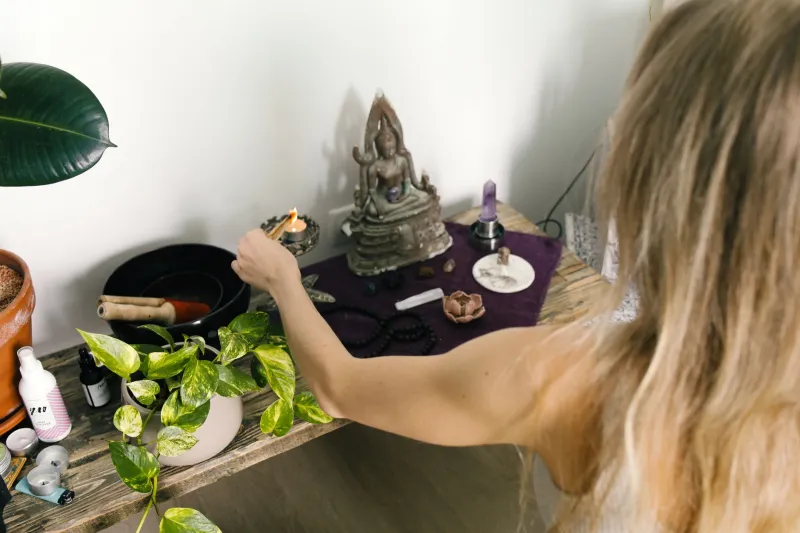
There is a particular kind of irony that does not escape Priya Venkataraman, a 29-year-old software engineer based in Austin. She grew up watching her grandmother sit cross-legged in front of a small deity shelf every morning before sunrise, eyes closed, lips barely moving. Nobody called it a wellness practice. Nobody charged her $14.99 a month for it.
"I downloaded three different meditation apps in college," Priya says, laughing a little. "And then one day I called my amma and described what I was doing, and she just went quiet for a second. She said, that's dhyana. We've been doing that for thousands of years."
That moment of recognition — the sudden understanding that something ancient and deeply personal had been repackaged and sold back to you — is one that resonates across South Asian American communities right now. And it's quietly sparking a reclamation.
The Wellness Industrial Complex and What It Left Out
The American meditation industry did not exactly arrive empty-handed. Apps like Calm and Headspace have genuinely helped millions of people manage anxiety and build stillness into overscheduled lives. That's real. But critics — including a growing number of South Asian wellness practitioners — point out that the pipeline from ancient Indian contemplative traditions to Silicon Valley-branded mindfulness has not been a neutral one.
Concepts like dhyana (the Sanskrit root that gave us the word Zen, via Chinese chán), nada yoga (the practice of using sound and inner listening as a meditative path), and mantra japa (the repetitive recitation of sacred syllables or phrases) have been flattened, stripped of their cosmological context, and turned into productivity tools. The silence that once held entire philosophical traditions has been optimized for better sleep scores.
"There's nothing wrong with using these tools," says Meena Iyer, a Dallas-based yoga therapist and second-generation Tamil American who teaches community classes. "But when the only version of meditation you're being sold is a white woman's voice telling you to breathe, and it costs more than your grocery budget, something has gone missing. And for us, what's missing is us."
Circling Back: Community Practice as Resistance
Across cities like Chicago, Houston, the Bay Area, and New Jersey — anywhere with a dense South Asian diaspora — informal practice circles have been forming. Some happen in living rooms. Some in temple community halls after the main programs end. Some on university campuses, organized by South Asian student associations that have started carving out space for contemplative practice alongside the dandiya nights and biryani potlucks.
These gatherings tend to share a few things in common: they're free, they're open, and they're rooted in specific traditions rather than a generic, culturally neutral "mindfulness."
In Fremont, California, a group of about fifteen people meets twice a month for what they loosely call a nada yoga circle. The sessions include listening exercises drawn from Hindustani classical music theory — attending to the anahata nada, the unstruck sound — along with guided mantra meditation and extended silence. The organizer, Rahul Krishnaswamy, started it three years ago after burning out on both his corporate job and a meditation app habit that left him feeling, as he puts it, "calm but disconnected."
"I went back to books. To my grandfather's practice. To asking questions I hadn't asked since I was a kid," he says. "And then I thought, I can't be the only one doing this."
He wasn't.
Dhyana Isn't an App Feature
Part of what makes this reclamation feel different from a simple cultural nostalgia trip is the intellectual seriousness people are bringing to it. Participants in these circles are reading primary texts — the Yoga Sutras of Patanjali, Abhinavagupta's Kashmir Shaivite writings, Tamil Siddha poetry. They're watching lectures from Indian scholars. They're calling their grandparents with specific questions.
For many second-generation South Asians, this is new territory. Their parents, often focused on assimilation and professional achievement, didn't always transmit the contemplative dimensions of their heritage. The puja happened, the festivals happened, but the why — the philosophical architecture underneath — sometimes got lost in the scramble to build a life in a new country.
"My parents prayed, but they didn't necessarily explain it," says Divya Sharma, a graduate student in Philadelphia who attends a mantra meditation group. "I had to go looking for the meaning myself. And when I found it, it felt like coming home in a way that no app had ever come close to."
What Authenticity Actually Costs
There is, of course, a tension here worth naming. Not every South Asian American has grandparents to call or a community center nearby. The diaspora is enormous and internally diverse — a Tamil Brahmin practice and a Punjabi Sikh practice and a Bengali Baul-influenced practice are not the same thing, and flattening them into one "South Asian tradition" risks its own kind of erasure.
Meena Iyer is careful about this in her own teaching. "I teach from the tradition I was raised in. I'm transparent about that. I'm not trying to represent all of South Asia," she says. "But I think what people are hungry for is specificity. They want to know where something comes from. They want the roots, not just the fruit."
That hunger for specificity is, in its own way, a kind of wellness practice — one that doesn't require a subscription, a retreat in Tulum, or a linen wardrobe. It requires curiosity, a willingness to sit with discomfort, and maybe a phone call to someone who has been sitting in silence before sunrise for decades.
The app can wait. Grandma already knew the way.