Dal on the Hot Plate: The College Students Cooking Their Way Home
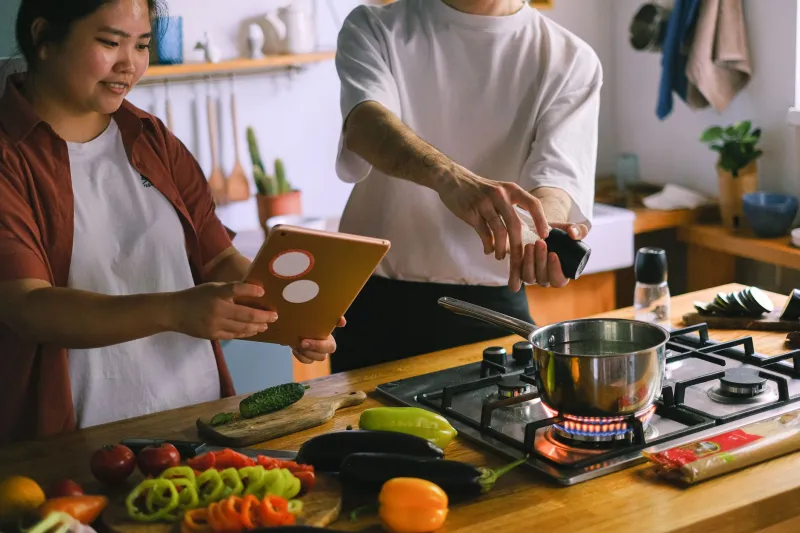
The contraband list in Anika Bose's freshman dorm room at the University of Michigan read like a care package inventory: a single-coil hot plate her mother had technically not been allowed to send, a small pressure cooker, a ziplock bag of her nani's premixed spices, and a jar of homemade ghee that she kept under her bed because it smelled too good and she didn't want her roommate asking questions.
She made her first solo batch of chana masala in October of that year, crouched on the floor at eleven at night, the window cracked to keep the smoke alarm from going off. It tasted, she says, "about sixty percent right." She cried anyway.
"It wasn't just about the food," she says now, a junior majoring in public health. "It was about the fact that I could make it. That I knew how. That it was mine."
The Cafeteria and the Culture Gap
For South Asian American students arriving at predominantly white institutions — or really, any campus where the dining hall's idea of "international food" tops out at a generic stir-fry station — the absence of familiar food can hit differently than expected. It's not just a craving. It's a daily reminder of how much of your context doesn't travel with you.
The cuisine of a South Asian household is not just flavor. It's a calendar. It's a map of regional identity. It's your mother's particular way of tempering mustard seeds, your father's insistence on a specific brand of basmati, the way your grandmother's kitchen smelled on festival mornings. When that's gone, something larger goes with it.
"People underestimate how much of your sense of self is tied up in what you eat," says Kavitha Nair, a first-generation Indian American and food studies researcher at NYU. "For diaspora students especially, food is often the most immediate, sensory connection to home. When it disappears, there's a real grief there."
Tiny Kitchens, Big Statements
What's fascinating is what students are doing with that grief. Rather than simply adapting — swapping idli for overnight oats and moving on — a notable number of South Asian students are leaning in. Hard.
At UC Berkeley, a group of South Asian students started an informal supper club two years ago that now draws thirty-plus people to a rotating host's apartment every few weeks. Each gathering is organized around a specific regional cuisine — one month it's Gujarati thali, another it's Bengali fish preparations, another it's a deep dive into Sri Lankan cooking. People bring dishes they've called home to learn, recipes transcribed from voice notes recorded during FaceTime sessions with aunties.
"There's something almost rebellious about it," says Rohan Pillai, one of the organizers, who is from a Malayali family in New Jersey. "We're at these elite institutions where we're supposed to be becoming one thing, and instead we're in someone's kitchen at nine PM arguing about whether the coconut milk is the right consistency for a Kerala curry."
The rebellion is real, even if it's delicious.
Documenting Before It Disappears
Beyond the supper clubs, social media has become an unexpected archive. Students are turning to TikTok, Instagram Reels, and YouTube not just to share recipes but to document them before they're lost — to capture the knowledge that lives in grandparents' hands and won't survive in any cookbook.
Sneha Agarwal, a sophomore at Boston University from a Rajasthani family, has been posting videos of her recreating her dadi's recipes for the past year. The process, she explains, is more complicated than it sounds. Her grandmother cooks by instinct — a handful of this, a pinch of that, the heat turned down "when it smells right." Translating that into something reproducible has required multiple phone calls, some failed batches, and a lot of patience.
"She doesn't measure anything," Sneha says. "So I'm basically doing culinary detective work. But I'm also realizing how much knowledge she carries that nobody ever wrote down. It feels urgent to get it down now."
Her videos — low-production, shot on her phone in her apartment kitchen — have found an audience that surprises her. Comments from other South Asian students saying this is exactly my grandmother's version or I didn't know anyone else made it this way have turned the project into something communal.
Food as a Full-Spectrum Identity
What's worth noting is that this isn't a simple "heritage preservation" story. These students are not cooking in amber. They're experimenting — making dal with ingredients from the corner bodega when the Indian grocery is forty minutes away, improvising with what the dining hall's salad bar can offer, fusing regional traditions because their own families already crossed those lines.
Anika's chana masala has evolved since that first contraband batch freshman year. She's added a technique she picked up from a Punjabi classmate. She's started finishing it with a squeeze of lime because she ran out of the tamarind her mom sent. "It's mine now," she says. "Like, it came from my family but it's also become something I made."
That negotiation — between inheritance and invention, between what was handed down and what you're building yourself — might be the most South Asian American thing about the whole project. The kitchen, always a place of transmission, becomes a place of translation.
And occasionally, of smoke alarms narrowly avoided.